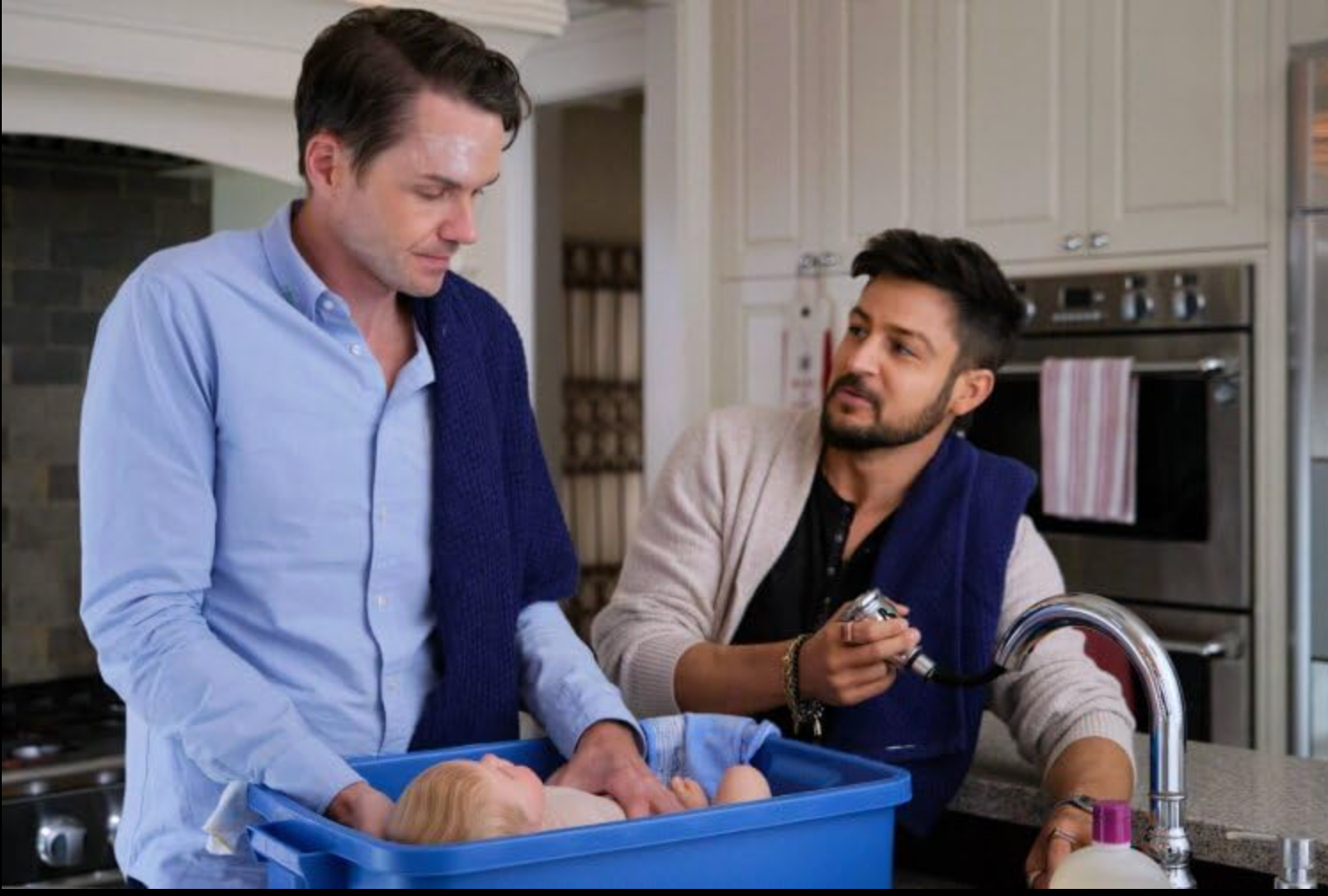
In a movie built around an inherently high-concept premise, this is one of the most understated moments in Three Wise Men and a Baby—and one of its most revealing.
Two brothers stand at a kitchen sink, bathing a baby in a plastic tub. There’s no music cue pushing emotion. No joke punctuating the action. Just towels over shoulders, careful hands, and the focused attention of people doing something they didn’t expect to be doing, but are fully committed to doing well.
It’s the kind of scene many viewers barely notice the first time. And it’s exactly why it works.
When Responsibility Becomes Routine
Earlier in the film, caregiving is disruptive. Everything feels improvised, temporary, slightly chaotic. Here, it’s procedural.
The towels are ready. The water is measured. One brother handles the baby; the other manages the practical details. There’s coordination without discussion—an unspoken understanding that suggests this isn’t their first time anymore.
That shift matters. The movie isn’t interested in showing perfection. It’s showing familiarity. And familiarity is where real change lives.
Why the Kitchen Matters
The choice of setting is deliberate. This isn’t a nursery or a designated “baby space.” It’s the kitchen—the most functional room in the house.
By staging the bath here, the film collapses the boundary between adult life and caregiving. The baby isn’t contained in a separate world. He’s integrated into theirs.
This is domestic life adjusting itself, not being rearranged for effect.
Masculinity Without Commentary
