There’s a moment in Three Wise Men and a Baby where the movie stops circling its idea and finally embraces it. This is that moment.
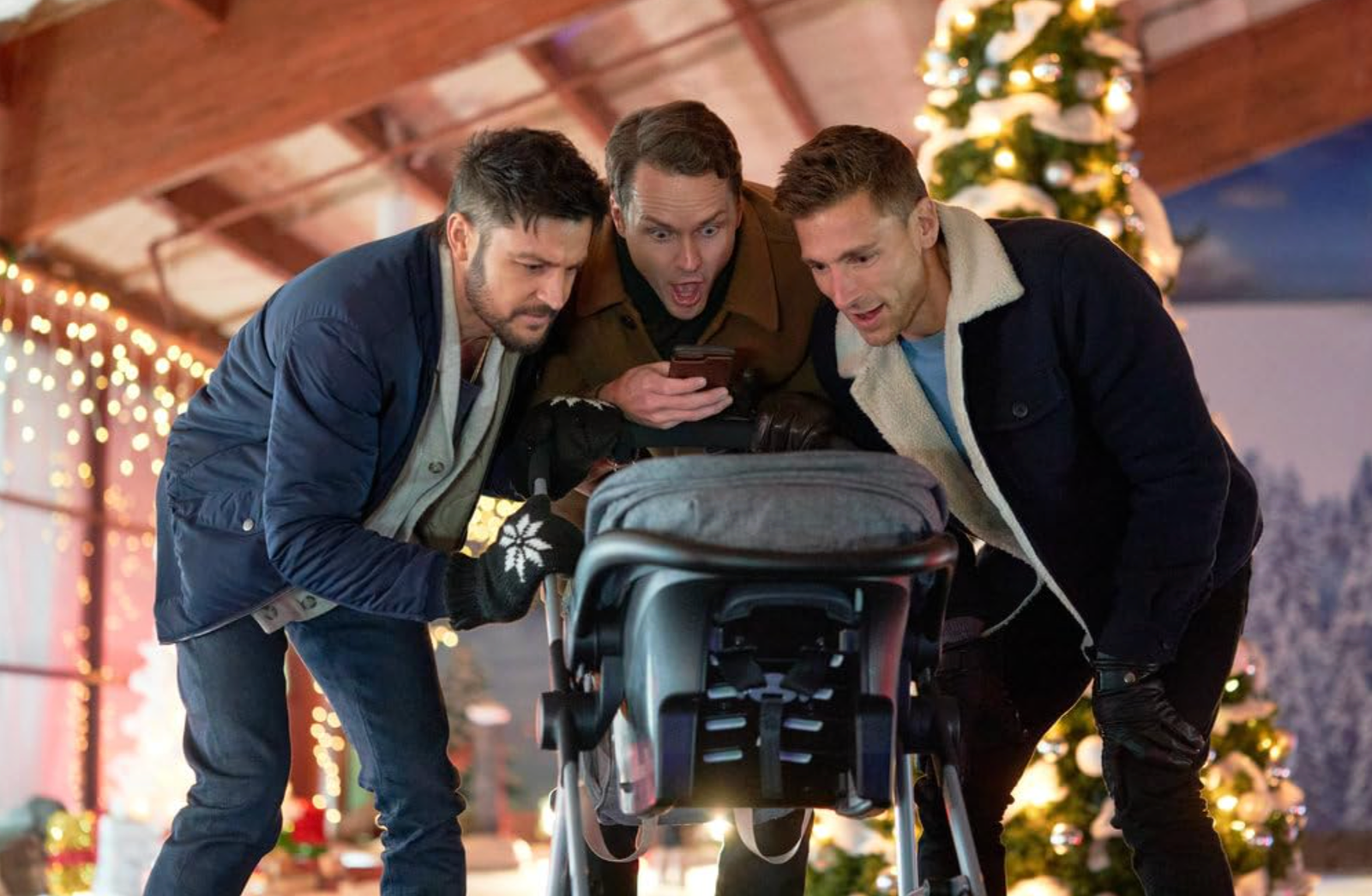
Three men lean in around a stroller, winter coats on, Christmas lights glowing behind them. One checks his phone. The others hover, alert, slightly tense, fully invested. It’s not played for slapstick, and it’s not overly sentimental. Instead, it lands somewhere more difficult—and more effective: responsibility taken seriously, in real time.
When the Movie Stops Winking at the Audience
Up to this point, the film balances humor with hesitation. The brothers react to the baby, manage logistics, argue over details. The tone flirts with chaos. Here, that changes.
This scene doesn’t treat the stroller as a prop or a punchline. The camera angle places it at the center, with the men physically bending toward it. Their posture tells the story: attention focused downward, bodies angled inward, no one disengaged.
They’re no longer reacting to the situation. They’re participating in it.
The Stroller as a Narrative Line in the Sand
Visually, the stroller becomes a boundary. On one side is their old rhythm—individual priorities, personal space, autonomy. On the other is something that demands coordination and presence.
What’s striking is how naturally the film lets this happen. There’s no speech about stepping up. No emotional cue music pushing the audience. Instead, the transformation is shown through behavior: checking details, hovering protectively, sharing concern without theatrics.
It’s subtle, but decisive.
A Shift From Comedy to Competence
