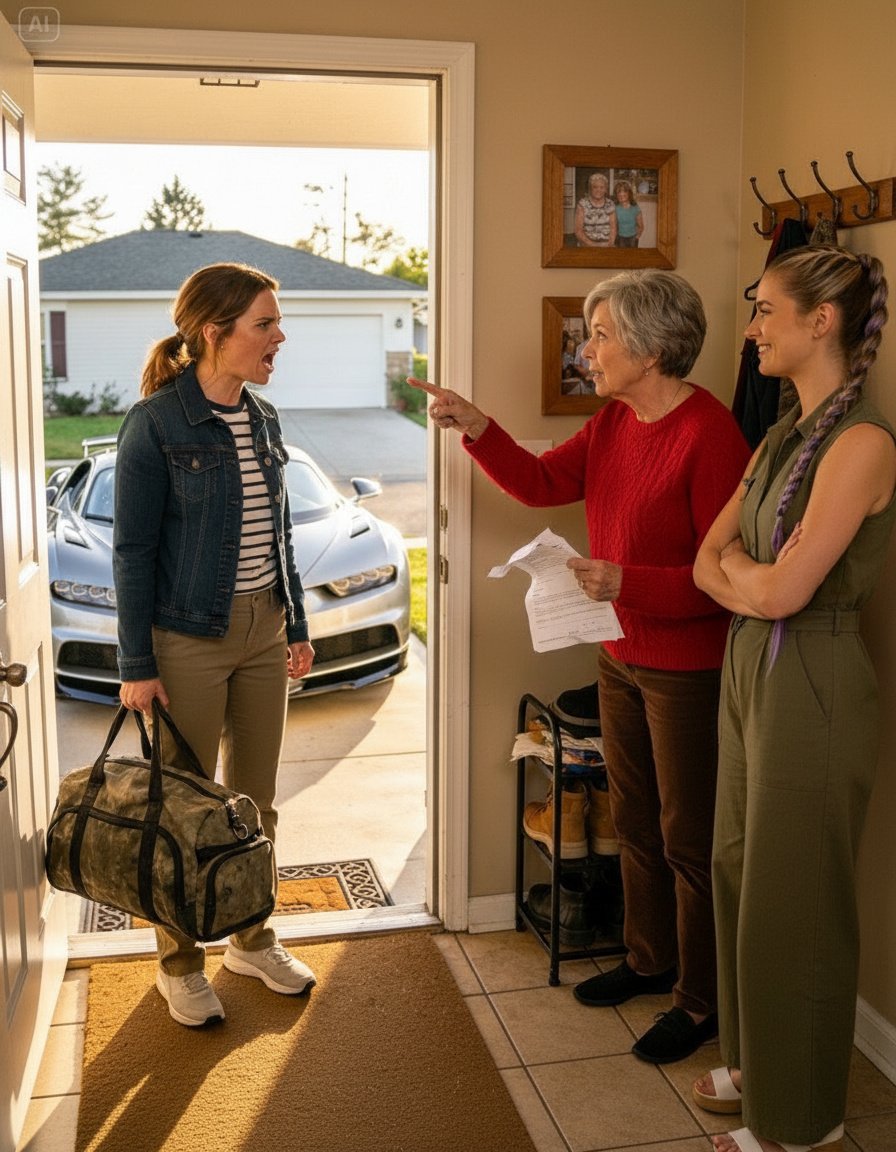
My name is Lauren Parker, and the day my mother kicked me out started like any other grueling Monday. I had just transferred my last savings—eight thousand dollars—to pay my younger sister Mia’s community college tuition and the back rent on our tiny two-bedroom house in Columbus, Ohio. I was working two shifts as a nurse at St. Vincent’s Hospital, dozing in my car in between nights and surviving on scraps from the hospital cafeteria. Still, I convinced myself it was worth it. Mom always insisted that family has a backbone. I believed her wholeheartedly. Just in time.
When I walked into the driveway that afternoon, my mind was still foggy from a twelve-hour shift. The silver Camry was gone, and Mia’s beat-up Kia was crooked as usual. The yard was the same—sparse grass, plastic flamingos, the tilted mailbox—but something in my chest tightened, as if I were walking into a place where I’m no longer wanted.
I opened the front door and stopped dead in my tracks. The hallway reeked of bleach and cheap floral spray. Boxes were lined up against the walls, labeled in thick black marker in Mom’s neat handwriting: “Kitchen,” “Bathroom,” “Mia’s Books.” My sneakers squeaked against the freshly mopped floor as I hurried toward my room.
The door was wide open. My stomach sank.
Everything was gone. The posters, the secondhand dresser, the mismatched nightstands she’d pieced together from Craigslist. Even the old single mattress. The blinds were bare, sunlight spilling onto an empty carpet, marked by vacuum cleaner lines. In the center of the room lay a solitary, tied-up garbage bag, like a deliberate insult.
I was still frozen when Mom approached me. “Good,” she said in a monotone. “You’re home now.”
I turned around, waiting for an explanation, hoping some terrible misunderstanding would be cleared up. “Mom… what happened to my things?”
She looked at me with a coldness I’d never seen before. “Lauren, you can’t carry this burden here anymore,” she snapped. “You’re almost thirty. I can’t wait any longer for you to sort out your life. Put away your trash bag and find a new home.”
Her words shocked me. “I just paid the rent,” I said, barely moving. “And Mia’s registration. You asked me…”
“That money was for this family,” she interrupted. Her cheeks were flushed, her gaze sharp and icy. “And this family needs space. Mia will have your room. She really does have a future. I won’t let you ruin it with your endless drama and bills.” Finished Goods Store.
Mia appeared in the doorway behind her, phone in hand and lip gloss gleaming. “Are you really still here?” she asked disdainfully. “Mom, I thought you’d already told her.”
My eyes felt hot. “I’ve worked tirelessly for you,” I said softly. “For both of us.”
Mom rolled her eyes and brushed past me as she walked toward the kitchen. When I followed her, still trying to reason with her, she grabbed a mug from the counter, half full of lukewarm coffee. “I said we’re done!” she yelled, and with a sharp flick of her wrist, threw the coffee directly at my chest.
The mug shattered in the sink as the hot, bitter liquid soaked my uniform. Mia giggled from the doorway, amused. Mom pointed at the trash bag on the floor like a judge passing sentence.
“Come out, Lauren,” he said. “Tonight.”
I left that night with a garbage bag over my shoulder and the coffee hardening on my uniform. The October air pierced the thin fabric as Mom slammed the door. Mia was standing by my old window, phone in hand. I climbed into my dented Honda, stared at the house for three seconds, and then drove to the only place that still felt like home: the hospital.
My head nurse, Jessica Moore, was finishing up the patient charts when I walked into the night shift office. “Parker, you look wrecked,” she said. In the break room, I told her everything: how I’d paid Mia’s rent and tuition, how they’d emptied my room, how Mom had thrown coffee on me when I asked why. Jess listened, her jaw clenched.
“So you left the lights on and they kicked you out,” he said. “You’re not coming back. Take your backpack. You’re staying with me.”
Their sofa bed became my refuge. That first night, gazing at the ceiling dotted with stars that twinkled in the darkness, I made myself a promise: I would never again beg for space in a family that only valued my paycheck. If I was going to exhaust myself, it would be building a life that no one could take from me.
The next few years were exhausting, but straightforward. I rented a small studio, took every extra shift, and poured my spare time into online courses in healthcare IT. The deeper I delved, the clearer it became: hospitals didn’t just need more staff; they needed smarter systems. Jess joked that I was trying to “go back to my childhood by coding,” but she also passed my resume to a visiting executive at MedLink, a rapidly growing healthcare technology company.
At 29, I traded bedside nursing for an analyst position. The raise wasn’t dramatic, but the stock options were substantial, and the work energized me. I helped develop tools that reduced recording time and detected medication errors. Our CEO, Angela Flores, took notice. Within a few years, I was leading a product team, working late into the night to develop solutions that made nurses feel valued.
When MedLink went public, the shares I had quietly accumulated were suddenly worth more than all my salaries combined. I paid off my loans, bought a downtown apartment, and traded in my Honda for a brand-new Tesla.
The Bugatti came later: a clear turning point. After completing a complicated acquisition, an investor invited me to a luxury car show. I ordered the complimentary champagne and found myself standing in front of a pearl-white Bugatti Mistral, reminded of the car magazines my father used to bring home. Buying it seemed like a risky decision, and yet, a completely wise one. My hand trembled as I signed the papers, and then I drove off in a machine that sounded authoritative.
Despite everything, I had no contact whatsoever.
The message that slipped through now and then—”Hey, could you help us just this once?”—was deleted without a reply. Therapy gave me words to describe what happened: parentification, financial abuse, scapegoating. It also gave me permission to stay out of trouble.
Then I received an email from Mr. Greene, our former landlord. He was retiring and intended to sell the house. “I thought you might want to have the right of first refusal,” he wrote. “You were always the responsible one.”
