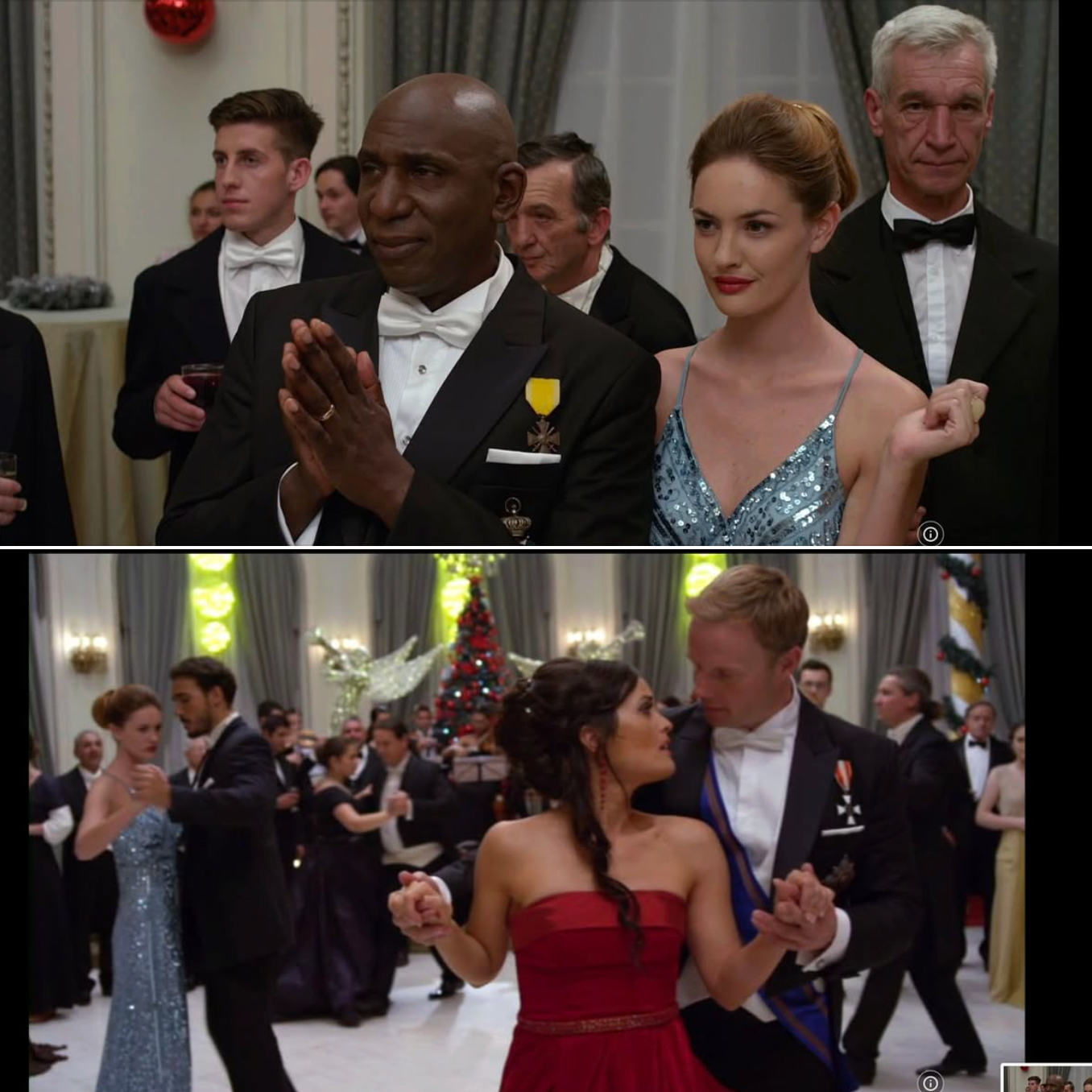
One of the most quietly sophisticated aspects of Crown for Christmas is how it portrays envy — not through villains or confrontation, but through observation.
These two scenes work together to show something very specific:
when an outsider steps into royal intimacy, the court doesn’t object loudly — it watches.
And watching, in royal spaces, is power.
🧠 Scene One: Envy Disguised as Politeness
In the first moment, the royal circle stands composed, applauding, acknowledging — doing exactly what decorum demands.
But beneath that politeness is calculation.
This is not admiration alone. It’s evaluation.
The glances are controlled. The reactions are measured. No one challenges the moment — but no one looks away either. In royal society, envy rarely shows itself as anger. It appears as restraint.
These are people who understand hierarchy instinctively — and they recognize when something threatens to rearrange it.
Not because of ambition.
But because of intimacy.
👀 Scene Two: When Envy Turns Personal
The second moment deepens the tension.
Now, the connection is undeniable — public, visible, impossible to dismiss. The dance isn’t just romantic; it’s a declaration in motion.
This is where envy sharpens.
The surrounding nobles are no longer simply observing a guest. They are witnessing access — emotional access to a figure they themselves are distanced from by protocol, rank, or history.
That’s where envy lives in royal spaces:
-
Not in wanting the throne
-
But in wanting closeness
-
Not in power, but in being chosen
The court understands something critical in this moment:
this connection was not granted — it was earned.
And that makes it unsettling.
⚖️ Why Envy Matters More Than Opposition Here
